Lead service line replacement is about removing old lead pipes that connect public water mains to buildings. This is fundamentally different from treating water with chemicals or adding filters. The goal is to take the lead out of the ground entirely.
Millions of lead service lines installed from the late 1800s through the mid-20th century still exist in U.S. communities today. Current estimates suggest over 6 million known lead service lines remain in use, with another 3 million lines of unknown status. These aging pipes represent a persistent source of lead in drinking water that cannot be fully addressed through treatment alone.
Even low levels of lead exposure can harm health, especially for young children and pregnant people. Public health research has consistently found that there is no known safe level of lead in drinking water. This reality has reshaped how utilities, regulators, and communities think about lead infrastructure.
Lead issues can occur even when treated water leaving the treatment plant meets all quality standards. The problem is often in the small pipes closest to homes and businesses—the service lines that run from the water main under the street to the building’s water meter or first point of use.
Recent national attention, new federal rules, and rising public expectations have shifted the focus from managing lead levels to removing lead infrastructure altogether. This represents a fundamental change in how water utilities approach this legacy issue.
Here is what has changed:
This article gives municipal leaders and utility managers a high-level view of what lead service line replacement is, why it is now a national expectation, and how it affects long-term planning.
A lead service line is the small pipe that runs from the water main under the street to the building. In most communities, this line is split between two owners: the utility typically owns the portion from the main to the property line, while the property owner is responsible for the customer owned side from the property line to the house.
The term “lead service line” is often used broadly to include:
Lead was commonly used in water service lines across many U.S. cities from roughly the 1880s through the 1950s, and in some areas through the 1980s. Lead was valued for its durability and workability. Installation continued legally in many jurisdictions until the 1986 Safe Drinking Water Act amendments banned new lead pipes for drinking water use.
Even when tap water meets all regulatory standards at the treatment plant, corrosion can cause lead to leach from these pipes into the water that reaches your faucet. Factors like high acidity or low mineral content in water can accelerate this corrosion. Running cold water before use or using a water filter can reduce exposure, but these measures do not eliminate the source.
Understanding what is in the ground is now a key part of national expectations. Utilities are building inventories and maps of service line materials to determine the scope of work ahead. This data helps answer basic questions:
A simple way to think about it: the service line is the connection between the street and the building. It is not the water main itself, not the water meter, and not the interior plumbing or plumbing fixtures inside the house. It is the pipe that runs under the yard, often 50 to 100 feet long, connecting public infrastructure to private property.
Public health research has steadily reinforced that no level of lead exposure is truly safe. Lead bioaccumulates in the body and can cause developmental delays in children, cardiovascular issues in adults, and other serious health effects. This scientific understanding has driven national attention toward fully removing lead from drinking water pathways rather than simply managing exposure levels.
For decades, the primary strategy was relying on corrosion control chemicals, targeted sampling, and public education. These approaches remain important, but they are no longer considered sufficient on their own. The expectation has evolved toward actually removing lead infrastructure from the ground.

Updated federal rules for drinking water, along with high-profile contamination events since the 2010s, have made lead service line replacement a centerpiece of national drinking water policy. EPA’s lead and copper rule improvements now require community water systems to replace lead service lines within defined timeframes. This regulatory shift reflects lessons learned from incidents where reliance on corrosion control alone proved inadequate.
Key elements of this national expectation include:
The distinction between “partial” and “full” replacement matters. Evidence has shown that partial replacements—where only the public side is replaced—can actually increase lead levels temporarily by disturbing the private service line. This finding has driven the expectation that replacement means the entire line replaced, regardless of ownership.
National discussions now treat lead service line replacement as essential core infrastructure work. It is comparable in importance to main renewal or treatment upgrades. Water utilities are being asked not only to control lead levels today but to demonstrate a plan over the coming decades for removing lead service lines entirely. This is no longer an optional add-on program. It is a baseline expectation.
Earlier approaches to lead in drinking water focused on “managing” the risk. This meant adding corrosion control chemicals to the water, sampling at high-risk locations, providing public education about flushing taps, and distributing water filters. These strategies aimed to reduce lead exposure without removing the lead pipes themselves.
That approach has not disappeared, but it is now viewed differently. Corrosion control and monitoring remain important as interim protections while replacement work proceeds. They are no longer considered permanent substitutes for lead service line replacement.
The contrast between these two approaches is significant:
Managing Risk
Eliminating Infrastructure
Relies on ongoing chemical treatment
Removes the source permanently
Requires continuous monitoring
Simplifies long-term operations
Vulnerable to disturbances and chemistry changes
Provides durable, predictable protection
Depends on public behavior (flushing, filters)
Does not require ongoing public action
Leaves uncertainty about pipe materials
Creates verified, lead-free connections
Eliminating lead infrastructure simplifies long-term risk management. Once a lead line is removed and a new copper or other approved material is installed, the primary source of that exposure pathway is gone. The new pipe can last 20 to 50 years or more with minimal lead-related concerns.
Focusing on full replacement also reduces uncertainty. Construction disturbances, changes in water chemistry, and incomplete knowledge of pipe materials can all cause unexpected lead spikes in systems relying only on corrosion control. Removing the lead pipe eliminates these variables from the equation.
This shift reflects a broader infrastructure mindset. Investing once to remove a contaminant source is often more durable, predictable, and understandable to the public than ongoing mitigation alone. It is similar to how utilities think about replacing aging mains or upgrading treatment capacity—capital investments that reduce long-term operational risk.
Communities are increasingly expected to set clear replacement goals and timelines. Open-ended risk management strategies that depend on many changing variables are no longer sufficient. The expectation is a defined path toward a lead-free water system.
Lead service line replacement is now a strategic, multi-decade planning issue. It should be integrated into overall water system asset management and capital planning, not treated as a standalone project or short-term initiative.
Understanding where lead service lines are located affects decisions across the utility. Planners increasingly coordinate replacement work with:
This coordination can reduce costs significantly. Bundling lead service line replacement with other infrastructure projects avoids repeated excavation in the same locations and spreads mobilization costs across multiple work items.
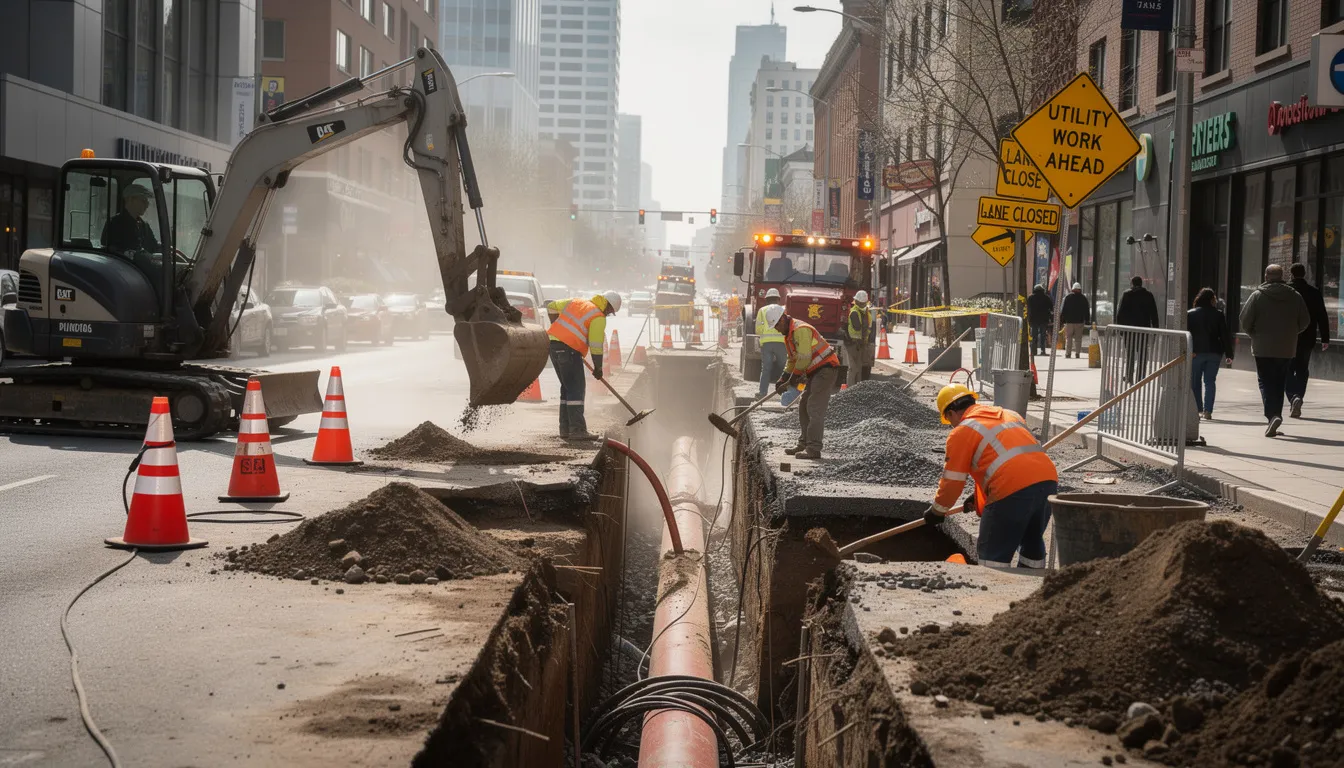
Planners should think in terms of system-wide priorities. Areas with older housing stock, communities with higher vulnerability to lead exposure, or neighborhoods with frequent main work may rise to the top. The goal is a rational approach to sequencing work over years or decades, not a prescriptive formula that applies everywhere.
Data quality matters enormously for planning. A more complete picture of service line materials allows utilities to:
Communication planning is part of long-term strategy. Communities increasingly expect clear explanations about what will be replaced, when, and what temporary precautions—like flushing or using a certified water filter—might be needed during and after the replacement process. Building public trust requires consistent, honest communication about timelines and progress.
Federal and state funding and financing resources now recognize lead service line replacement as a priority infrastructure need. Options include state revolving funds and dedicated allocations for lead removal. These programs can help protect ratepayers while utilities tackle the significant costs involved. However, funding alone does not solve the planning challenge—utilities still need to know where the lead is, how to schedule the work, and how to communicate with property owners who may need to sign right-of-entry forms to allow access to their private water service lines.
High-level planning considerations include:
This is infrastructure work that will define the next decade for many water utilities. The period from 2025 through 2035 is expected to be decisive, with systems achieving 5 to 15 percent annual replacement rates through proactive service line replacement programs.
Lead service line replacement represents a national shift from temporary control of lead levels to permanent removal of lead pathways in drinking water systems. This is not a trend or a policy preference. It is now a baseline expectation for community water systems across the country.
Municipal leaders and utility managers face a clear set of expectations: understand where lead service lines are, plan for their replacement over time, and integrate this work into broader infrastructure strategies. The question is no longer whether to remove lead service lines but how to do so efficiently and equitably.
Decisions made in the next decade will shape outcomes for years to come. The quality of service line inventories, coordination with other capital projects, and communication with the public will all influence how smoothly this work proceeds. Utilities that invest in good data and thoughtful planning now will be better positioned to meet deadlines and manage costs.
As communities gradually eliminate lead service lines, they simplify operations, reduce long-term risk, and strengthen public confidence in their water systems. The result is a more resilient and trustworthy drinking water infrastructure—one where lead exposure from service lines is no longer a concern.
Lead service line replacement is foundational work for modern water systems. It belongs alongside main renewal, treatment upgrades, and other core investments that define responsible utility management.
ALABAMA CUSTOMERS: See important notice regarding your state's sales tax.
"Seller has collected the simplified sellers use tax on taxable transactions delivered into Alabama and the tax will be remitted on the customer's behalf to the Alabama Department of Revenue.Seller's program account number is SSU-R012660449."